
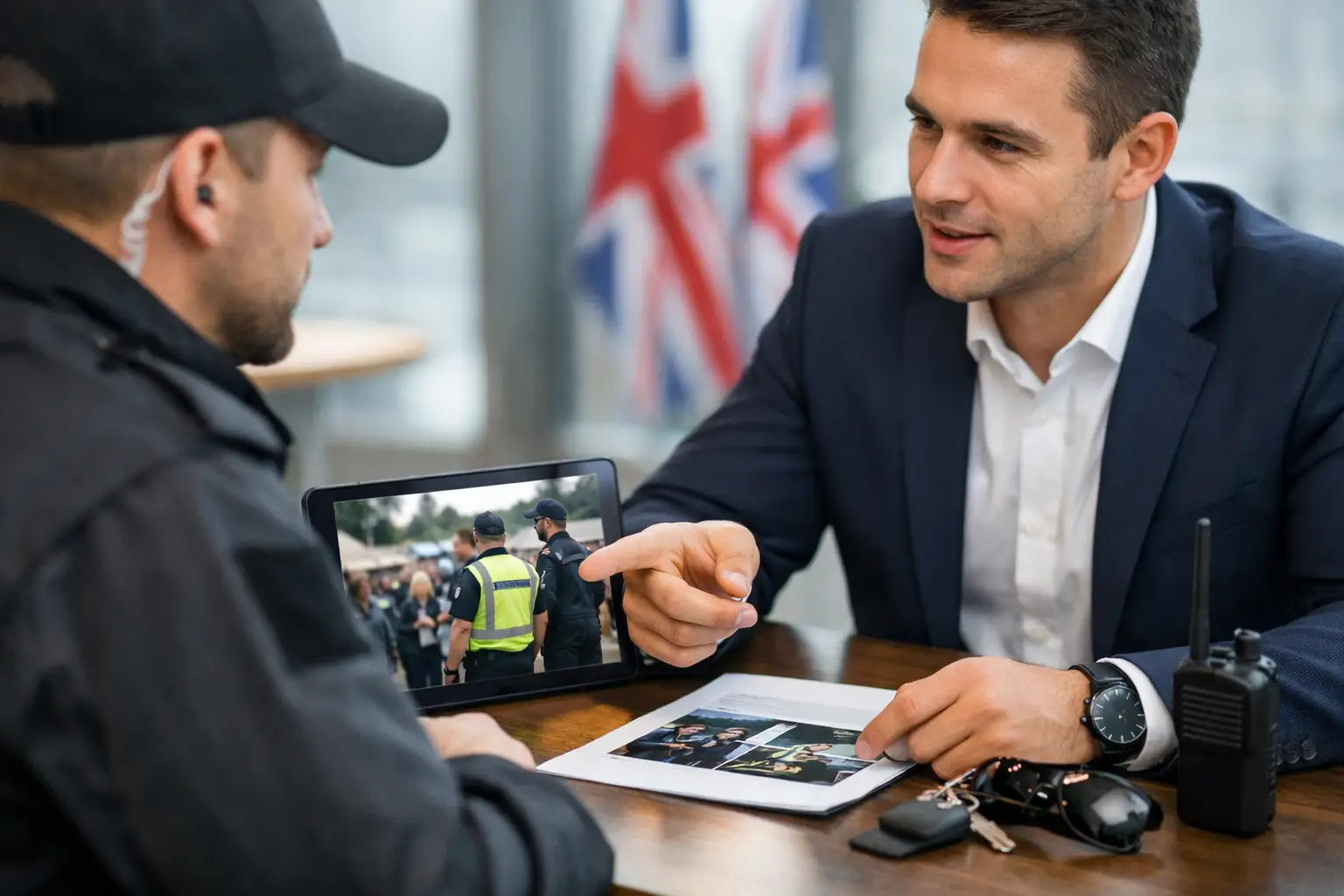
A poorly selected security provider can turn a manageable incident into an event-ending failure. When deciding how to choose an event security company, the priority is not simply filling a staffing number. You need a disciplined partner that understands your venue, audience, operational pressures and legal responsibilities – and can maintain control when conditions change.
For event organisers, venue operators and production teams, the right decision starts well before event day. It is made through clear scoping, evidence of competence and a provider’s willingness to plan properly rather than make vague assurances.
Start with the event risk, not the hourly rate
Every event has a different risk profile. A corporate awards evening, a stadium fixture, a music festival and a late-night venue event may all require licensed staff, but the deployment model, command structure and likely incident types will be very different.
Before requesting quotations, define the operational picture. Consider expected attendance, age profile, alcohol service, ingress and egress routes, VIP attendance, cash handling, restricted areas, traffic flow, contractor access, event timings and the history of the site or event. A supplier should ask searching questions about these details. If they can provide a price without understanding them, they are pricing bodies rather than planning security.
Cost remains a commercial consideration, but the lowest hourly rate can become expensive quickly if it results in insufficient supervision, poor staff positioning or an unprepared response to disorder, medical incidents or evacuation. Compare like for like: staff numbers, roles, shift lengths, supervisory cover, planning time and reporting arrangements should be clear in every proposal.
Check licences, insurance and operational compliance
The baseline checks are non-negotiable. Personnel undertaking licensable activity must hold the appropriate SIA licence, and the provider should be able to confirm that licences are checked and recorded before deployment. This matters particularly where door supervision duties are required, including searching, refusal of entry, managing conflict or removal from a venue.
Ask about public liability insurance and employers’ liability insurance, as well as the provider’s processes for vetting, training and right-to-work checks. You are not looking for a folder of certificates alone. You are assessing whether the company operates a controlled system that will stand up to scrutiny following an incident.
There are practical distinctions to make. Event stewards may be suitable for customer-facing guidance, queue management, wayfinding and monitoring, while SIA-licensed door supervisors may be required where the role involves security activity. A credible provider will explain those boundaries and recommend the right mix. Using the wrong role to reduce cost creates avoidable exposure for the organiser.
Ask who holds command on the ground
An event security plan needs a clear chain of command. Establish who is the event security lead, who briefs the team, who makes decisions if conditions deteriorate and how that person communicates with your event manager, venue duty manager and emergency services.
For a small, low-risk event, one experienced supervisor may be sufficient. At a larger arena, festival or sports event, the structure may require sector supervisors, a control point and defined escalation routes. The answer depends on the scale and risk, but the principle does not change: every member of staff should know who they report to and what authority they hold.
How to choose an event security company that plans properly
The most useful test of a provider is the quality of its questions before it begins work. Good event security is built around site knowledge, not assumptions. The provider should want to review site plans, entry points, emergency exits, barrier layouts, crowd routes, production schedules and any known operational constraints.
Ask what documentation and briefings will support the deployment. Depending on the event, this may include assignment instructions, staff position plans, emergency procedures, communications protocols, incident-reporting arrangements and a pre-event briefing. These controls are not paperwork for its own sake. They give staff a consistent instruction set and give the organiser a defensible record of how the operation was prepared.
A proper briefing should cover the event purpose, expected audience behaviour, prohibited items, search policy where applicable, safeguarding concerns, emergency actions, radio protocol and escalation thresholds. It should also address the small details that cause friction on the day: staff arrival times, uniform standards, welfare arrangements, vehicle access and where to report concerns.
Be cautious of providers who promise that their teams will simply “use common sense”. Experience matters, but it works best within clear instructions. Structured briefings allow experienced personnel to exercise judgement without losing consistency.
Assess the people, not just the company profile
Security delivery is personal. Guests, artists, employees and contractors will judge your event partly by how security staff speak, listen and act. The team must be alert and authoritative without becoming unnecessarily confrontational.
Ask how staff are selected for the assignment. The right profile for a formal corporate reception may differ from the right profile for a busy concert hall or a football crowd. Familiarity with the venue type, confidence in customer interaction and the ability to de-escalate conflict should all influence deployment.
It is also reasonable to ask about continuity. Will the provider use a stable team and named supervisors, or are staffing arrangements still uncertain close to the event? Last-minute changes happen in security, but a reliable company has processes to manage absences, confirm replacements and maintain the required standard.
Look for calm incident management
No supplier can promise that an incident will never occur. What matters is how effectively the team identifies, contains, records and escalates it. Ask for examples of the provider’s incident process: how are concerns reported, who is informed, when is the client contacted and what written record is produced afterwards?
The best teams do not make routine issues more visible than they need to be. They deal with intoxication, disputes, unauthorised access and queue pressure early, professionally and proportionately. Where a matter requires escalation, they act decisively and preserve a clear account of events.
Test communication before you appoint
Your first conversations often show what event day communication will feel like. Are responses specific and timely? Does the provider identify gaps in your brief? Can they explain their recommendation in plain language? Do they confirm key decisions in writing?
Reliable communication is especially valuable when plans change. Guest numbers rise, a schedule moves, a performer arrives with additional personnel or weather affects access routes. You need a provider that can assess the implication, communicate the adjustment and deploy staff accordingly without creating confusion.
Make sure the proposal states what is included, who your main contact will be, notice periods for changes, minimum shift requirements and how additional staff can be requested. Clarity at this stage prevents avoidable disputes later.
Make the final decision on evidence and fit
A strong event security company should give you confidence for clear reasons: relevant operational experience, appropriately licensed personnel, defined supervision, disciplined planning and responsive communication. It should also understand that your event experience matters. Security must protect people and premises without creating unnecessary obstacles for legitimate guests.
Do not appoint on price, availability or polished sales language alone. Review the deployment recommendation against your actual risks, challenge anything that is unclear and confirm the command structure before committing. The right provider will welcome that scrutiny because accountable delivery begins with an informed client.
For planned event security across Reading, the Thames Valley, London and surrounding regions, contact Definitive Security Services at info@definitive-security.uk for a quote or consultation. A clear brief and early planning discussion will give your event the control it needs before the doors open.
Follow and like Definitive Security Services on Facebook for practical security guidance and operational updates.
Leave a Reply