
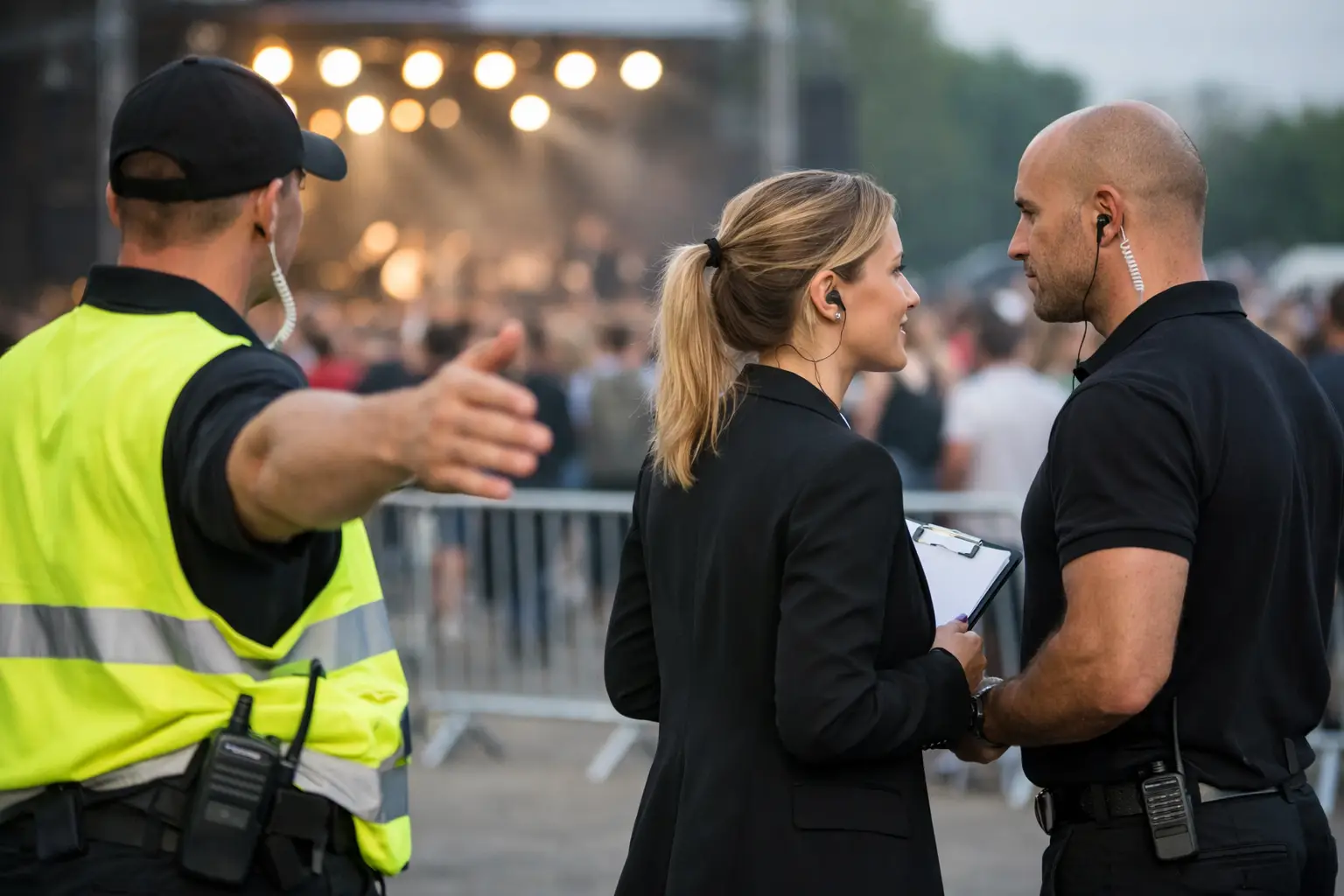
A well-run event rarely looks heavily controlled. Guests find the right entrance, queues move, accessible routes remain clear and minor issues are dealt with before they affect the wider crowd. That outcome relies on clear planning and the right people in the right positions. This guide to event stewarding roles is written for organisers and venue operators who need to specify, procure and manage a dependable stewarding deployment.
Event stewards are often the most visible members of an event operations team. Their work is not simply directing people or checking tickets. Properly briefed stewards support safe crowd movement, protect agreed access arrangements, observe developing issues and provide a calm point of contact for guests, venue staff and emergency services.
What event stewards do on a live site
An event steward’s duties are shaped by the venue, audience profile, attendance level, site layout and event risk assessment. A steward at a corporate conference will work differently from one at a football fixture, music arena or outdoor festival. The principle remains the same: maintain safe, orderly conditions within an allocated area and escalate concerns through the agreed command structure.
Typical responsibilities include managing queues and entry lanes, providing wayfinding information, monitoring walkways and exits, maintaining sterile areas, supporting evacuation procedures and reporting hazards or incidents. At busy events, stewards also help identify crowd density issues early, before a congested route becomes unsafe.
The strongest teams do not operate in isolation. They work to a site plan, radio protocol, incident reporting process and escalation route. A steward needs to know who their supervisor is, where the nearest emergency exits and welfare points are located, which areas are restricted, and what to do if conditions change.
Guide to event stewarding roles and deployment
There is no single stewarding template that suits every event. Buying a set number of people without defining their duties can leave critical areas uncovered or create confusion between the venue, organiser and security provider. A structured deployment starts with roles, positions and reporting lines.
Entry and queue management stewards
These stewards manage the first operational impression of the event. They guide guests towards the correct entrance, keep queues within designated barriers, communicate waiting times where appropriate and identify anyone who requires assistance.
Their presence reduces pressure at doors and prevents queues from obstructing public routes, emergency access or neighbouring businesses. At larger events, entry stewards should be positioned to support a clear separation between ticket checking, bag-search arrangements where required, guest services and any SIA-licensed security activity.
Audience, concourse and bowl stewards
For stadiums, concert halls and large live-event spaces, static positions inside the venue are essential. Stewards monitor aisles, gangways, stairs, exits and spectator areas. They provide practical information, respond to spillages or obstructions, and report behaviour or conditions that may affect safety.
A good position brief is specific. It should state the area boundary, nearest exit, capacity concerns, radio call signs, emergency actions and the person to contact when support is needed. Telling a steward simply to “watch the crowd” is not an operational instruction.
Access-control and back-of-house stewards
Restricted areas need consistent control, particularly at film productions, festivals, corporate events and venues with performers, contractors or VIP guests. Access-control stewards check that people use the correct route and display the appropriate accreditation or pass. They protect the integrity of loading areas, stage doors, production corridors and staff-only spaces without creating unnecessary friction.
This role depends on accurate information. If passes, access levels or delivery schedules change during the day, the stewarding team must receive that update promptly. Poor communication at back-of-house access points can delay production activity or allow unauthorised movement through sensitive areas.
Response, evacuation and welfare support stewards
Some stewards are assigned as mobile response resources within the event footprint, although they should still have defined patrol areas and a supervisor-led tasking process. They can support a developing queue, relieve a position, assist with a lost child procedure, direct guests during a partial closure or help clear a route for medical staff.
During an evacuation or shelter procedure, stewards do not improvise. They implement the venue or event plan: opening and protecting agreed egress routes, directing people to the correct location, checking assigned areas where safe to do so, and relaying accurate information to supervisors. This is why pre-event briefings and practice matter as much as headcount.
Stewards, security officers and door supervisors
Organisers should not assume that a steward can perform every security function. Event stewarding is primarily a customer-facing safety and crowd-management role. It may include observation, access support and the reporting of suspicious behaviour or prohibited items, but it is not a substitute for appropriately licensed security personnel where licensable activity is required.
The boundary must be clear before doors open. If an event requires searching, guarding against unauthorised access, dealing with disorder or removing people from premises, the deployment may require SIA-licensed security officers or door supervisors. The precise requirement depends on the activity, venue and legal framework, so the role design should be checked during event planning rather than decided at the gate.
This distinction protects guests, staff and the organiser. It also prevents staff from being placed in situations that exceed their training, authority or brief.
What reliable stewarding looks like
Reliability is not measured only by whether the team arrives on time, although punctuality is non-negotiable. It is visible in the discipline around the deployment: correct uniform, professional presentation, signed-in staff, clear role allocation, working communications and supervisors who know the event plan.
A quality provider should be able to explain how staff are selected for the environment, how shift briefings are delivered, how absences are covered and how incidents are recorded. For a multi-day festival or a high-attendance arena event, continuity also matters. Replacing experienced team members each day can weaken local knowledge and consistency.
Look for a briefing process that covers more than generic health and safety points. Staff need event-specific instructions on crowd profile, expected pinch points, prohibited items, transport arrangements, emergency procedures, safeguarding concerns, weather contingencies and client escalation contacts. A disciplined briefing gives stewards the confidence to act early and communicate clearly.
Planning the right number of event stewards
There is no safe universal ratio of stewards to attendees. A 500-person seated awards evening may require fewer operational positions than a lower-attendance outdoor event with multiple entrances, uneven ground and a busy public boundary. The right number depends on the layout and the tasks that must be covered at the same time.
Start with fixed posts: entrances, exits, accessible viewing areas, crossings, backstage doors, vehicle gates and high-footfall routes. Then allow for supervisors, breaks, relief cover and response capacity. If every steward is committed to a fixed post, there is no resilience when an incident, late arrival or sudden crowd build-up needs attention.
Cost should be assessed against this operational requirement, not treated as a simple hourly staffing calculation. Under-resourcing may appear efficient on paper but can lead to longer queues, unmanaged congestion, poor guest experience and costly disruption. Conversely, excessive staffing without defined tasks adds expense without improving control. The objective is a deployment that is proportionate, accountable and adaptable.
Questions to ask before appointing a provider
Before confirming stewarding support, ask how the provider will translate your event plan into staffed positions. Establish who leads the team on site, how briefing records are maintained, what happens if staffing changes at short notice and how incidents will be communicated to the organiser.
You should also ask how stewarding integrates with the venue team, medical provision, production staff and any door supervision or security officers. Separate teams working from different information create gaps. A single operational picture, shared at the right level, makes decisions faster and reduces contradictory instructions.
For events across Reading, London, the Thames Valley and the wider South of England, Definitive Security Services provides structured event stewarding deployments built around site-specific positions, briefings and supervisory control. The focus is straightforward: people who understand their task, communicate effectively and support the safe operation of your event.
The most useful stewarding team is one that guests barely notice because routes remain clear, questions are answered and problems are managed early. To discuss a forthcoming event deployment or request a quote, contact Definitive Security Services at info@definitive-security.uk.
Leave a Reply