
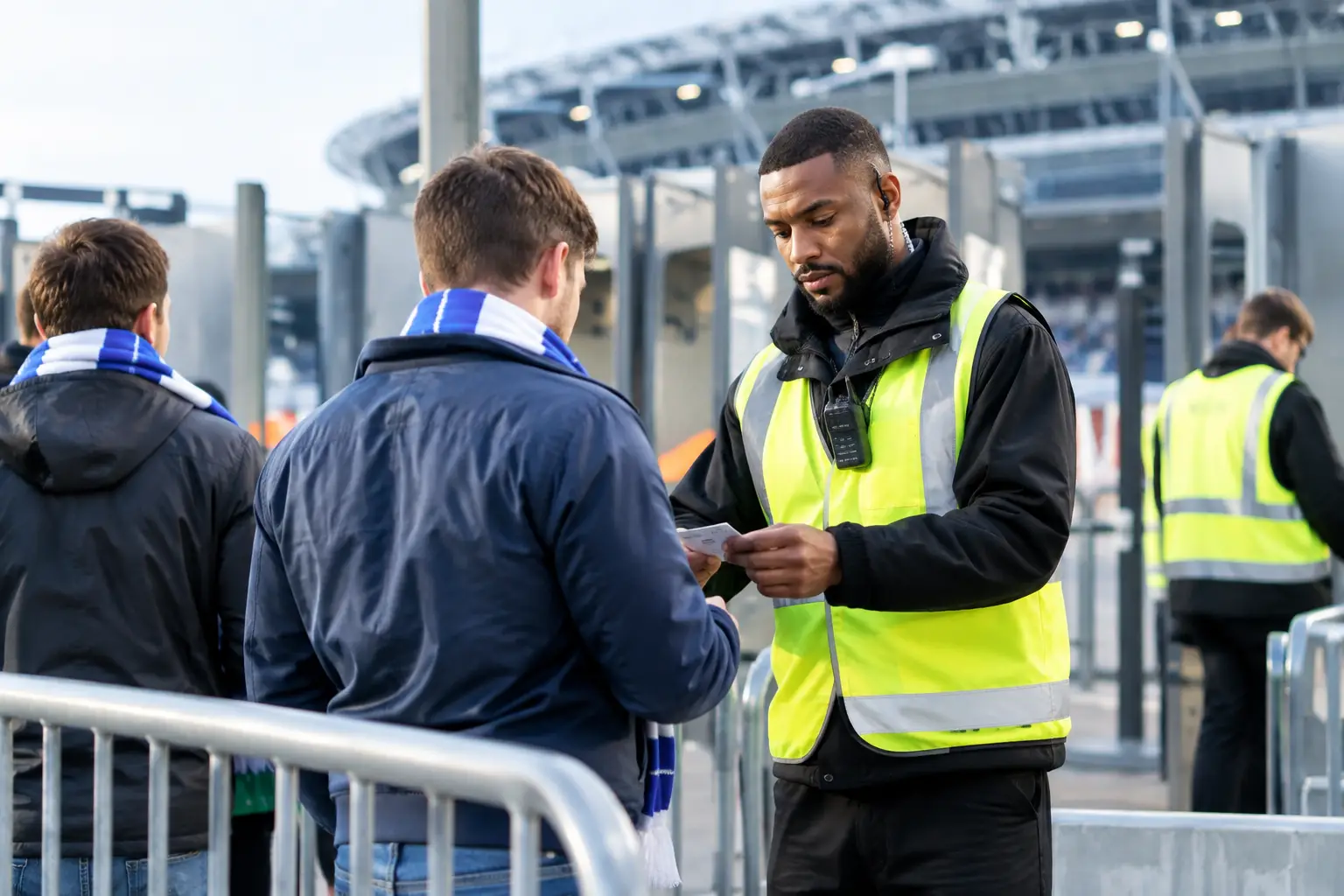
A full stadium changes character quickly. Turnstiles open, supporters arrive in groups, hospitality areas begin receiving guests, delivery activity overlaps with early admissions, and the pressure on every entrance point rises. Stadium security teams must bring order to that movement without creating unnecessary friction for legitimate visitors.
For a football, rugby or multi-use venue, match-day security is not simply a matter of placing officers at gates. It is a controlled operation built around preparation, clear roles, reliable communications and the ability to respond proportionately when conditions change. The quality of that operation affects spectator safety, the venue’s reputation, its licence obligations and the experience of everyone inside the ground.
Stadium security teams start work before gates open
The visible deployment is only one part of the job. Effective stadium security teams are planned against the fixture, expected attendance, crowd profile, kick-off time, transport pressures, weather, visiting supporters, hospitality requirements and any known local risks.
A lower-attendance midweek fixture may require a different approach to a high-profile derby, cup tie or event involving a large number of first-time visitors. The core standards should remain consistent, but numbers, access controls, search arrangements, segregation positions and supervisor coverage must reflect the actual risk. A fixed staffing model for every event can leave gaps in one area and unnecessary cost in another.
The pre-event briefing should establish who is responsible for each zone, where escalation sits, what to report and how to report it. Staff need clarity on prohibited items, entry conditions, ejection procedures, emergency access routes, safeguarding concerns and the arrangements for lost children or vulnerable adults. They should also understand the client’s priorities for that specific event, whether that is protecting a high-profile guest, maintaining supporter segregation or tightening controls around hospitality access.
Good briefing discipline prevents assumptions. It also gives supervisors a clear basis for accountability once the operation is under way.
Access control is a safety function, not a queueing exercise
Entry points are where poor planning becomes immediately visible. Long queues can create crowd pressure, frustrate supporters and increase the likelihood of confrontation. At the same time, rushed searching or inconsistent ticket checks can allow prohibited items, intoxicated individuals or unauthorised persons into the venue.
The answer is not simply to search everyone more slowly. It is to organise the process properly. Lanes should be clearly controlled, staff should understand the search standard expected of them, and supervisors should be positioned where they can resolve issues before they become blockages. Separate arrangements may be required for players, officials, media, contractors, hospitality guests and disabled spectators.
Consistency matters. If one entrance applies a firm bag policy while another allows the same item through, staff lose authority and queues become harder to manage. Clear pre-event messaging helps, but the frontline team must still be prepared to explain decisions professionally and remain calm when challenged.
Crowd management depends on observation and communication
Most crowd issues develop before they become incidents. A build-up of people at a concourse bar, an obstruction near a stairwell, tension between supporter groups or a sudden surge towards an entrance all require early recognition. Static positioning has a role, but teams also need supervisors and experienced officers who are actively reading the environment.
Communication must be concise and useful. Radio traffic should identify the location, the nature of the issue and the support required without creating confusion across the wider operation. Supervisors must then decide whether the situation can be resolved locally, requires additional staff, or needs venue management and emergency service involvement.
The correct response is not always a heavy-handed one. A calm conversation, a change to pedestrian flow or a discreet repositioning of staff may resolve a developing issue without drawing a crowd. Where firm intervention is necessary, it must be lawful, proportionate and supported by clear reporting. The objective is control, not confrontation.
Segregation needs active management
For fixtures with identified rival support, segregation cannot be treated as a barrier plan alone. It includes arrival routes, entrances, concourse areas, toilets, smoking zones, exit timings and post-match dispersal. A gap in any one of these areas can undermine the wider arrangement.
Teams should know the trigger points that require an immediate response, such as supporters moving into restricted areas, attempts to enter through the wrong turnstiles or groups gathering near a designated separation line. Supervisors should also be able to move staff quickly when the crowd pattern differs from the expected plan.
The right stadium security team balances service and authority
Spectators remember how they were treated. A professional officer who gives clear directions, assists a family finding the correct block or handles a complaint with composure contributes to the event experience. That service mindset does not weaken security. It makes compliance more likely and reduces avoidable conflict.
However, customer service should never mean tolerating unacceptable behaviour. Abuse towards staff, attempts to bypass access controls, persistent refusal to follow instructions and actions that place others at risk require a firm response. The team’s authority comes from consistent standards, professional presentation and support from supervisors, not from unnecessary aggression.
This balance is particularly important in hospitality areas and premium seating. Guests may expect a more discreet style of security, but access rules and venue standards still apply. Staff should be able to protect the environment without becoming intrusive or allowing entitlement to override procedure.
Incident response must be structured
No venue can eliminate every incident. What distinguishes a disciplined operation is how it responds. Medical emergencies, disorder, suspicious items, pitch incursions, fire alarms and evacuations all demand different actions, but the same principles apply: confirm the facts, communicate clearly, protect people, preserve access for responders and record what happened.
A well-led team does not allow every officer to rush towards the same incident. That can leave other areas exposed and create further crowd-control problems. Supervisors should direct resources, maintain coverage at critical points and keep venue control informed throughout.
Post-incident reporting is equally important. Reports should be factual, timely and specific, with accurate times, locations, actions taken, descriptions of those involved and any available witness details. Vague reports create risk for the venue and make it harder to identify repeat issues or improve future deployments.
Welfare and safeguarding are operational priorities
Stadium operations involve children, older spectators, disabled guests, individuals affected by alcohol or drugs, and people who may be distressed or separated from their group. Staff must know how to recognise vulnerability and who to alert.
A lost child should not be treated as a routine customer-service query. A person showing signs of serious intoxication may need medical assessment rather than removal alone. A safeguarding concern requires confidentiality, sensitivity and prompt escalation through the venue’s agreed process. These situations test both the competence and judgement of the team.
Reviewing the match day improves the next one
The final whistle is not the end of the operation. Egress is often the point at which tiredness, alcohol, disappointment and transport delays combine. Exit routes, barriers, nearby roads and public transport locations need active oversight until the site is clear and the agreed handover is complete.
A short operational debrief should follow every significant fixture. This is where supervisors can identify pressure points: a turnstile that repeatedly caused delays, an under-resourced concourse, unclear access instructions, recurring disorder in a particular block or a communications issue that slowed the response. The value lies in turning those observations into changes before the next event.
For stadium operators, the procurement decision should therefore focus on more than headcount. Ask how the provider plans deployments, briefs staff, manages supervision, communicates during incidents and reports after the event. The cheapest shift rate can become expensive if it produces inconsistent standards, poor records or an avoidable incident.
Definitive Security Services provides disciplined event and venue security support for stadiums, sports grounds and large-scale events across the South of England and beyond. To discuss a forthcoming fixture or request a quote, contact info@definitive-security.uk. Follow and like Definitive Security Services on Facebook for practical security updates and operational guidance.
Leave a Reply