
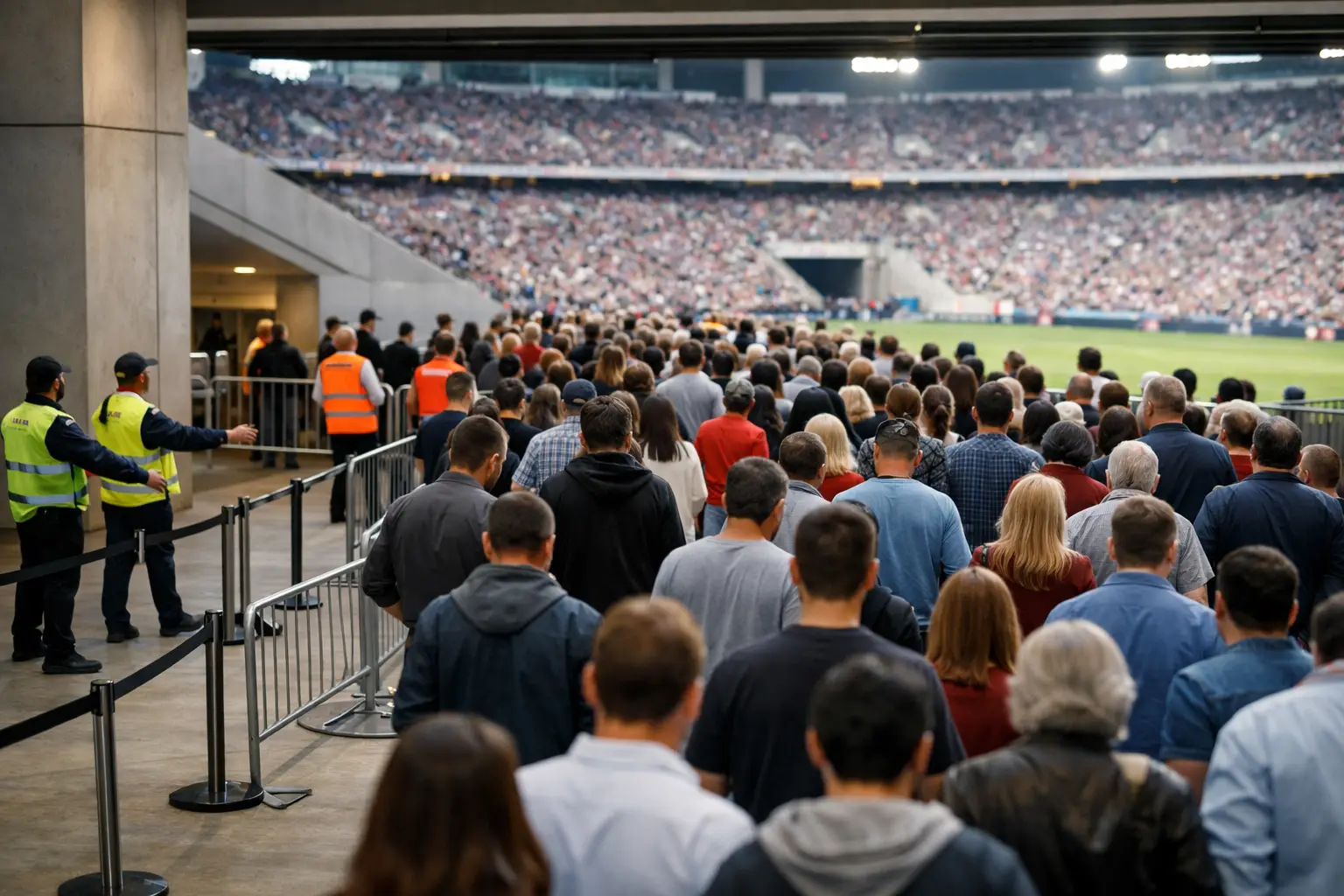
A crowd-flow failure rarely begins at the point where people stop moving. It often starts earlier: an unclear arrival message, a turnstile taken out of service, a poorly positioned queue barrier, or a concourse route narrowed by catering queues. Knowing how to manage stadium crowd flow means treating the spectator journey as one connected operation, from transport interchange and perimeter queues to the final exit.
For stadium operators, promoters and event directors, the objective is not simply to move the greatest number of people through a gate. It is to maintain safe, predictable movement while protecting access routes, preserving emergency egress and giving staff time to intervene before pressure builds. This requires planned deployment, capable supervisors and clear information at every decision point.
How to Manage Stadium Crowd Flow Before Gates Open
Effective crowd management begins well before the first spectator arrives. The event plan should map expected volumes by arrival time, entrance, ticket category, transport mode and audience profile. A sold-out football fixture, a family sporting event and a concert with a young standing audience can create very different movement patterns, even at the same venue.
Start by identifying every pinch point. These commonly include pedestrian approaches, bag-check lanes, ticket scanning areas, turnstiles, stairwells, vomitories, concourses, toilets, food and drink outlets, lifts and accessible viewing routes. Measure usable space rather than relying on a site plan alone. Temporary structures, advertising units, queues and parked equipment can materially reduce available width.
Entry capacity must be tested against realistic conditions. A gate may process spectators quickly in ideal circumstances, but throughput falls when tickets will not scan, bags require further checks, visitors need assistance or a late surge arrives from a delayed train service. Build contingency into staffing and layout rather than assuming every entry lane will operate at its maximum rate.
The pre-event briefing should give every steward and security officer a shared operating picture. Staff need to know their zone, reporting line, escalation process, radio call signs, access-control rules and the trigger points for intervention. A vague instruction to “watch the crowd” is not enough. Teams should understand what rising density, queue crossover, blocked exits and counterflow look like in their own area.
Design routes people can understand immediately
Spectators make fast decisions based on signs, barriers, visible staff and what the people around them are doing. Where routes are unclear, crowds tend to follow the most obvious path, even if it leads towards a restricted gate or a congested concourse.
Use clear, consistent directional signage from the outer perimeter onwards. Separate home and away supporters where required, distinguish hospitality and accessible entrances, and make queue starts visible before guests reach the gate line. Physical barriers should guide movement without creating dead ends or trapping people against fixed infrastructure.
Staff positioning matters as much as signage. A steward at the first decision point can prevent a hundred people taking the wrong route. Officers should face the direction of approaching footfall, remain visible and use concise, calm instructions. Their role is not merely to react when a queue forms, but to influence movement early.
Control Entry Without Creating New Pressure
Security screening and ticket checks are essential, but they must be integrated into the wider flow plan. Overly intensive checks at every lane can create a long external queue; insufficient control can allow prohibited items, unauthorised access or ticket misuse to enter the venue. The right balance depends on the event risk assessment, audience profile, venue design and current threat picture.
Create a layered entry process where possible. Initial queue management and ticket readiness checks can take place before the final search or turnstile point. This helps identify guests with ticket issues, oversized bags or incorrect entry information before they reach the narrowest part of the system.
A dedicated exception lane is particularly valuable. Guests who need help with digital tickets, accessibility arrangements, accreditation or secondary searches should be moved out of the main stream promptly. Otherwise, a single unresolved issue can stall an entire lane and cause those behind to compress forward.
Supervisors should monitor queue length, density and processing speed continuously. If pressure rises, they need practical options: open a prepared lane, redeploy trained personnel, direct people to a lower-volume entrance, pause arrivals at an outer holding area or issue clear public messaging. These decisions are most effective when made early, not after the crowd has already become frustrated.
Manage Movement Inside the Stadium
Once spectators are inside, crowd flow becomes less linear. People are moving to seats, toilets, concessions, smoking areas, hospitality spaces and viewing points, often against the direction of others. Half-time and full-time are predictable stress points, but a goal, weather change, evacuation of a stand or an entertainment interval can alter behaviour quickly.
Zone the venue so supervisors can maintain accountability. Each area should have an identified lead, adequate radio coverage and a direct route for support staff to reach it. Fixed posts must not leave critical routes unattended when staff are pulled into minor incidents, so relief arrangements should be planned in advance.
Keep gangways, stairwells, vomitories and emergency exits free from avoidable obstruction. This means actively managing informal queues at bars and food outlets, preventing spectators from gathering in circulation areas and addressing standing in routes where it creates a blockage. A visible, respectful intervention at the first sign of obstruction is normally easier than dispersing a dense group later.
It is also essential to separate routine customer service issues from genuine safety concerns. A lost ticket, a seating query or a complaint about a queue may be resolved by a trained steward. Aggressive behaviour, attempted forced entry, crowd surges or repeated non-compliance require immediate escalation through the command structure. Clear thresholds prevent confusion and ensure senior decision-makers receive accurate information.
Use communications as an active control measure
Public announcements, screen messages and steward instructions should support the same operational plan. Conflicting messages create hesitation and cause people to stop in circulation areas. Keep instructions practical: state where people should go, which entrance is available and what action is required now.
Radio discipline is equally important. Teams should report facts: location, direction of travel, approximate numbers, behaviour observed and immediate obstruction. Messages such as “busy by the bar” do not give a control room or supervisor enough information to make a proportionate decision.
For high-attendance events, maintain regular updates between operations, safety, medical and security leads. Conditions can change within minutes, and the response may involve opening an alternative route, changing steward positions, adjusting public messaging or requesting support at a specific location. The value of a structured command chain is that decisions are recorded, understood and acted on without delay.
Plan the Exit as Carefully as the Arrival
Departure is often the highest-pressure phase because large numbers leave within a short period, frequently towards limited transport, car parks or town-centre routes. The end of the event should not be treated as the point at which staffing can stand down. It is when route protection, external liaison and disciplined deployment are most needed.
Staggered release can reduce pressure where venue design and event conditions allow it, but it must be clearly communicated and fairly managed. Holdbacks should only be used where there is a defined purpose, suitable space and appropriate supervision. Holding people without explanation can increase frustration and lead to unnecessary confrontation.
External routes need the same attention as internal ones. Consider barriers, crossing points, taxi ranks, coach loading areas, car-park pedestrian routes and separation between different supporter groups where relevant. Weather, darkness and public transport disruption can all increase the need for visible, well-briefed staff after the final whistle or encore.
Choose a Provider That Plans Beyond the Post List
A staffing schedule alone is not a crowd-flow plan. When appointing event security and stewarding personnel, decision-makers should look for evidence of site-specific briefings, experienced supervisory cover, clear incident reporting and the ability to adapt deployment when operational conditions change.
Ask how the provider assesses pinch points, how it records and escalates crowd concerns, who has authority to redeploy staff, and how relief is managed during long events. Cost matters, but the cheapest headline rate can create greater exposure if it results in inexperienced staff, weak supervision or insufficient cover at critical routes.
Definitive Security Services provides disciplined event security and stewarding support for stadiums, arenas and live events across Reading, London, the Thames Valley and surrounding regions. For a quote or consultation on your stadium event requirements, contact info@definitive-security.uk. Follow and like Definitive Security Services on Facebook for practical security updates and operational guidance.
Leave a Reply