
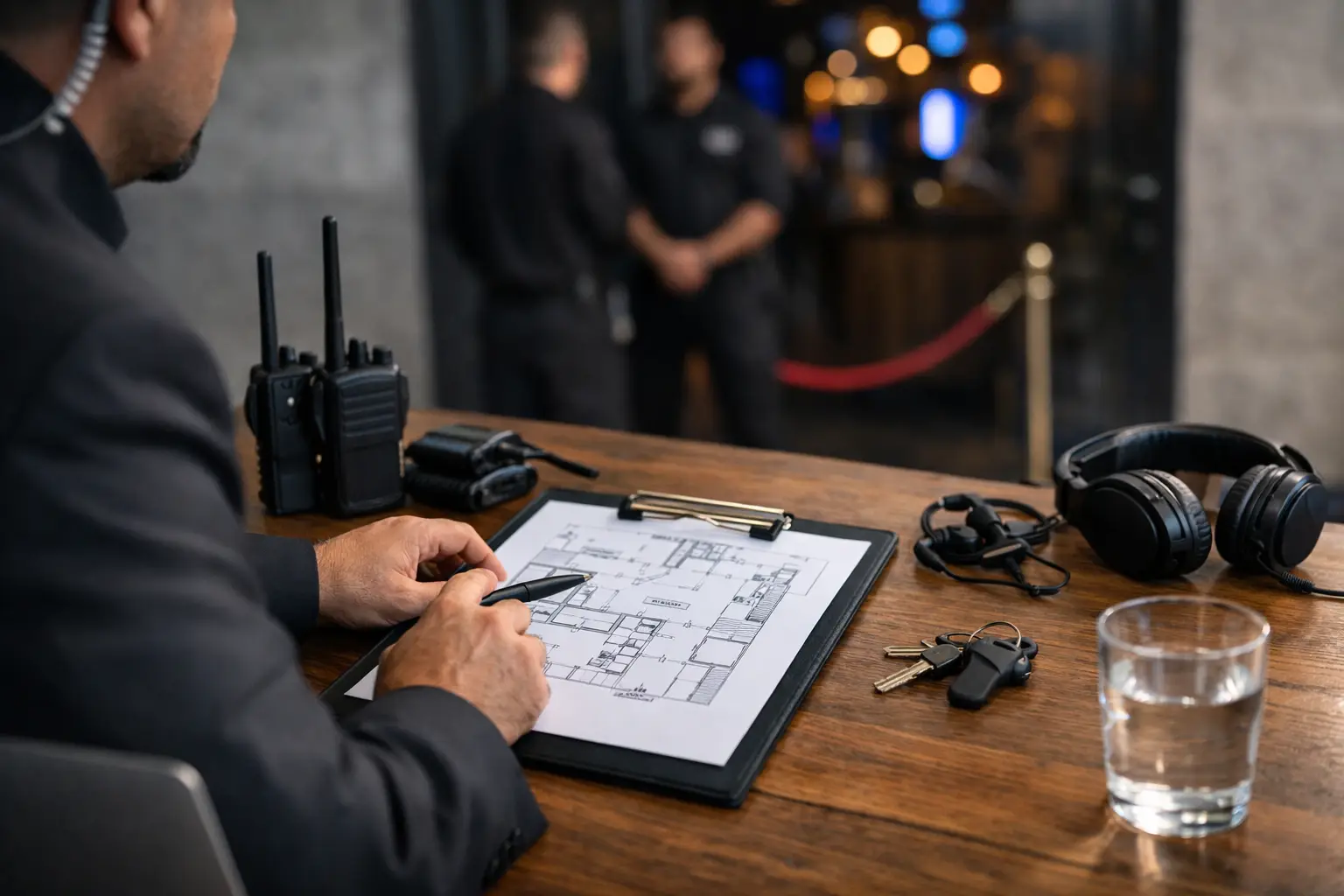
A quiet Friday can become a difficult one in less than ten minutes. A queue forms earlier than expected, one customer arrives already intoxicated, a local incident shifts footfall towards your venue, and your front-of-house team is suddenly working beyond its plan. That is why knowing how to plan door supervision matters. Good door supervision is not just about putting licensed staff on a door. It is about controlling entry, reducing risk, protecting staff, supporting the venue licence, and maintaining order without unnecessary escalation.
For venue operators, event organisers and facilities teams, the planning stage is where most of the outcome is decided. If the plan is weak, even experienced door supervisors are left reacting to problems that should have been anticipated. If the plan is disciplined, the team can work with clarity, confidence and accountability.
How to plan door supervision from the risk outward
The starting point is not headcount. It is risk. A nightclub operating until 3am has a different risk profile from a members’ bar, a late licensed restaurant, a live music venue or a ticketed sporting event. The crowd type, admission policy, alcohol profile, local environment, transport arrangements and likely pressure points all shape the deployment.
Begin by assessing what the door team is actually there to do. In some venues, the priority is age verification and refusal management. In others, it is queue control, bag checks, searching, managing re-entry, or dealing with conflict linked to intoxication and drugs. Some sites need strong control at the front entrance. Others need a layered approach that includes smoking areas, internal patrols, emergency exit monitoring and safe dispersal at close.
This is where many plans go wrong. A client asks for two door supervisors because that is what was used last year, or because it fits a budget line. That may be enough, but it may also leave gaps in search coverage, gender-specific searching, break relief or incident response. A proper plan tests the actual operating requirement rather than repeating the previous booking.
Define the operating model before assigning staff
Once the risk picture is clear, the next step is to define how the venue or event will operate. Door supervision must support the way the site runs, not work as a separate function.
You need to be clear on opening hours, admission cut-off times, search policy, challenge procedures, capacity thresholds, queuing arrangements, VIP access, contractor access and what happens when someone is refused entry. If the venue has a dispersal policy, that needs to be reflected in deployment through to close and beyond, not treated as an afterthought.
For licensed premises, the relationship between management and security needs to be explicit. Who has authority to refuse entry? Who makes the final decision on ejections? How are incidents recorded? When is police support requested? If there is no clear command structure, small issues become confused quickly.
A strong plan also accounts for customer flow. Door supervisors should not be positioned purely where there is space to stand. They should be placed where they can control access, observe behaviour, communicate with one another and intervene early. Sightlines matter. So do lighting, radio coverage and proximity to management support.
Staffing numbers depend on more than attendance
Attendance is only one factor in deciding team size. A crowd of 300 seated guests at a private function is not the same as 300 people arriving for a club night with open admission. Behavioural risk, arrival pattern and venue layout often matter more than raw numbers.
As a rule, staffing should reflect the workload at each control point. If searches are required, the process must be efficient enough to avoid unmanaged queues. If female searching is needed, that must be planned in, not improvised. If one officer is tied up dealing with a refusal or incident, the entrance still needs to remain controlled.
Experience level also matters. A team of competent door supervisors still needs leadership. On larger or more demanding deployments, assigning a supervisor or team leader is not optional. It improves decision-making, client communication and incident management, particularly when the environment changes during the shift.
Briefing is where the plan becomes operational
A door team should arrive knowing more than the start time and dress code. The briefing needs to establish the task, the risks, the expected standards and the escalation routes.
At minimum, the team should understand the site layout, entry and exit points, licence conditions, key contacts, radio channels, search policy, refusals policy, vulnerable person procedures, emergency arrangements and reporting expectations. They should also know the client priorities. Some venues are primarily concerned with preserving a premium customer experience. Others are focused on strict admission control and a visible deterrent presence. Usually, it is a balance of both.
Good briefings are specific. Telling a team to keep an eye on trouble is not a briefing. Telling them that a local fixture has finished at 9.45pm, that increased footfall is expected from one direction, that challenge thresholds must be applied consistently, and that all refusals are to be logged with management gives the team something operationally useful.
For recurring venues, there is a temptation to rely on familiarity. That is risky. Even experienced teams need shift-specific updates. Staffing changes, local incidents, promoted events, known individuals, weather conditions and transport disruption can all affect the operating environment.
Build the communication and reporting structure
Door supervision fails fastest when communication is poor. The team needs reliable radio procedure, a clear line to venue management, and agreed thresholds for escalating incidents. This is particularly important in busy night-time settings where conditions can change quickly.
Communication planning should cover routine and exceptional circumstances. Routine communication includes queue updates, capacity alerts, welfare issues and refusals. Exceptional communication includes violence, suspected drug activity, medical incidents, safeguarding concerns and evacuation support.
Reporting should be planned with the same discipline. If your expectation is that incidents will be recorded, define how and by whom. If body-worn video is in use, staff must know the activation policy and evidence-handling process. If management wants end-of-night handovers or incident summaries, that should be built into the shift structure.
This level of control is often what separates a professional security operation from a basic staffing arrangement. The value is not just in responding to incidents. It is in creating an evidence trail, identifying patterns and protecting the client if a complaint, licence review or insurance query follows.
How to plan door supervision for different environments
The right plan depends on the venue type. A nightclub may require strong front-door control, search capability, queue management, internal floor coverage and close-down support. A live event may need separate ticket validation, bag checks, pit or stage-front support and coordinated egress management. A hotel bar may need a lower-profile approach focused on access control and discreet intervention.
There is also a difference between public-facing and closed environments. A private corporate function with a guest list can still require door supervision if the risk of protest, unauthorised entry or alcohol-related conflict exists. Equally, some lower-volume sites need a more customer-service-led presence rather than overtly firm control at the door. That balance should be planned deliberately.
Location can affect the operating model as well. A town-centre venue in Reading on a weekend faces different footfall and dispersal pressures from a destination site with controlled arrivals. Local knowledge helps, but it should support the plan rather than replace it.
Compliance, conduct and proportionality
Any door supervision plan must sit within legal and licensing expectations. That includes using properly licensed operatives, applying search and refusal policies lawfully, recording incidents accurately and ensuring that any intervention is necessary and proportionate.
For the client, this is not just a compliance issue. It is a reputational one. Poorly briefed or poorly controlled security staff can damage customer experience, create complaints and increase legal exposure. Strong planning protects standards of conduct as much as it protects the entrance.
It is also worth being realistic about trade-offs. A highly visible security posture may deter problems, but it can feel heavy-handed in some hospitality settings. A softer approach may suit the brand better, but only if the team still has the authority, staffing level and support to act decisively when needed. The right answer depends on the environment, the audience and the risk appetite of the operator.
Review the deployment, not just the incidents
The final stage in planning is often the one most frequently missed – review. If the only question asked after a shift is whether anything serious happened, you miss the operational detail that improves future performance.
Review whether queues were controlled, whether search throughput was sufficient, whether break cover created gaps, whether the radio procedure worked, whether refusals were handled consistently and whether management had the information they needed. Near misses matter. So do recurring low-level issues that have not yet become serious incidents.
For ongoing contracts and repeat events, review should feed straight back into the next plan. That is how deployment becomes sharper over time. Definitive Security Services approaches door supervision in that way – as an operational function built on planning, briefing and control, not simply attendance at the front entrance.
If you are working out how to plan door supervision, start by asking a harder question than how many staff you need. Ask what the operation needs to achieve, what could go wrong, and what structure allows the team to stay ahead of it. That is usually where better outcomes begin.
Leave a Reply