
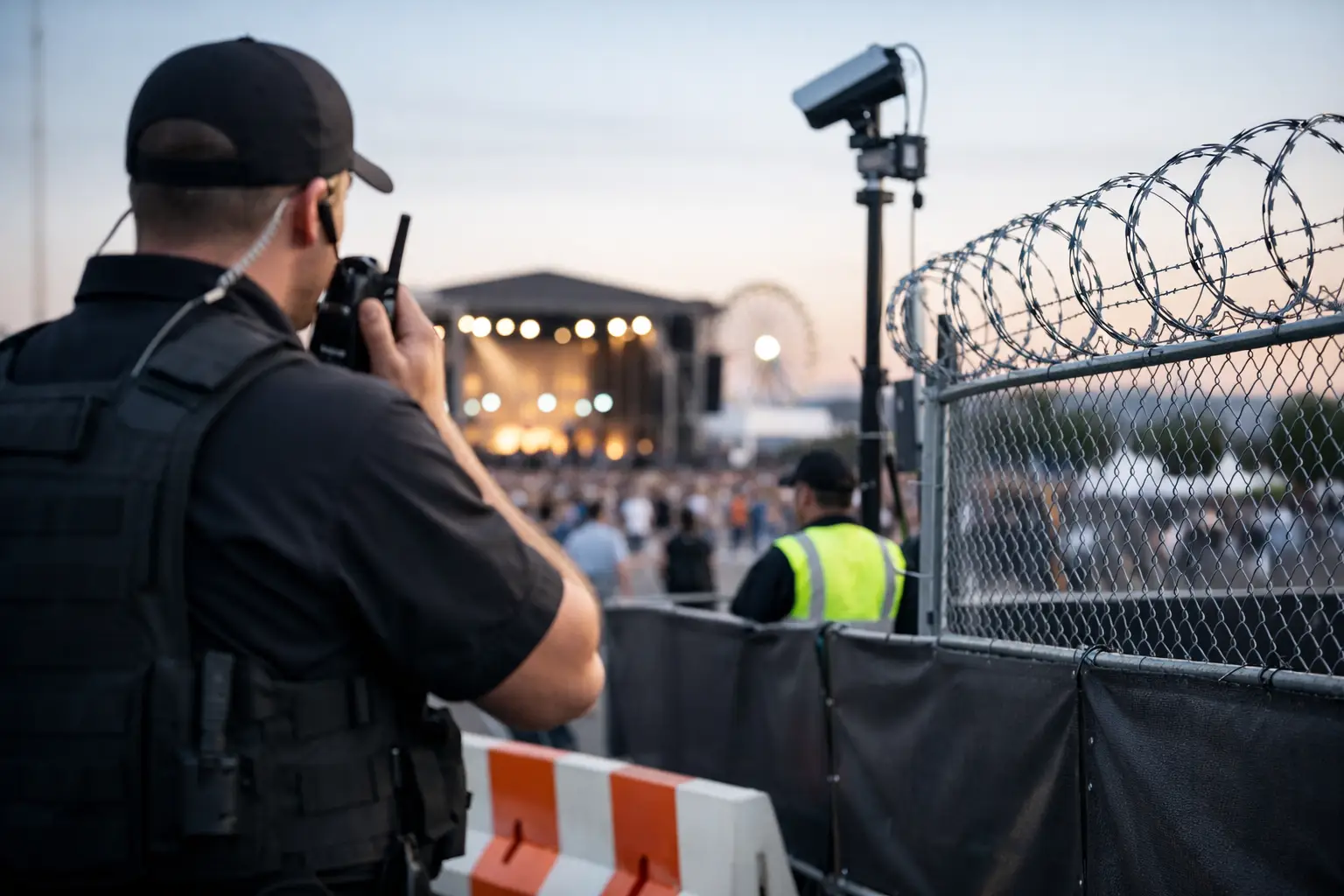
A perimeter failure rarely starts at the fence line. It usually starts earlier – with unclear zoning, weak ingress planning, poor briefing discipline or a mismatch between the crowd profile and the control measures in place. That is why any serious guide to event perimeter security has to begin with planning, not barriers.
For event organisers, venue operators and operations leads, the perimeter is where duty of care becomes visible. It is the point at which ticketed access, public safety, anti-intrusion measures, safeguarding and emergency procedures meet. Get it right and the event starts in a controlled way. Get it wrong and pressure builds quickly, from queues and frustration through to trespass, disorder, theft or unsafe crowd movement.
What event perimeter security is actually responsible for
Perimeter security is often reduced to fencing and guards on gates. In practice, it is a wider control system designed to regulate who gets in, who stays out, how people move, and how incidents are detected and contained before they spread into the live event space.
That means the perimeter has several jobs at once. It has to deter unauthorised entry, channel legitimate attendees towards the right access points, support ticket and accreditation checks, protect restricted areas, and give supervisors a workable outer line for escalation. On some sites, it also has to separate public space from licensed space, protect plant and production compounds, and maintain sterile zones for emergency access.
The level of control depends on the event. A community show on open parkland needs a different perimeter model from a stadium concert, a food and drink festival or a football fixture. The principle is the same, though – the perimeter should match the event risk profile rather than follow a generic staffing pattern.
Start with a perimeter risk assessment
A useful guide to event perimeter security must be clear on one point: the perimeter plan should come from the risk assessment, not the other way round. Too many deployments begin with a rough headcount for guards and stewards, then try to fit that resource to the site. That approach leaves gaps.
The better method is to assess the site footprint, expected attendance, admission model, event timings, likely pressure points and known threat factors first. Consider whether the event is fully ticketed or partially open, whether alcohol is present, whether there is a history of gate rushing, theft, protest activity or attempted freeloading, and whether the venue sits within a busy public environment.
Site layout matters just as much. A perimeter that borders retail space, housing, transport links or public footpaths creates different access challenges from a self-contained venue. Likewise, temporary event sites often carry blind spots, uneven fencing lines and service access issues that need to be designed out through patrol patterns and physical controls.
Define the perimeter in layers, not as one line
The most effective event perimeters are layered. Treating the boundary as a single outer line makes the whole operation brittle. If one gate comes under pressure or one section of fencing is compromised, there is no depth to the response.
A layered model usually includes the outer boundary, controlled ingress points, internal sterile zones and restricted operational areas such as production compounds, cash handling points, artist areas, plant locations or medical routes. This creates options. It allows a team to contain an issue at the edge, slow movement before it reaches the audience area, and protect critical spaces even if crowd pressure increases elsewhere.
This is particularly important on larger sites where attendees, contractors, staff, performers and suppliers may all be entering through different routes. Separate channels reduce friction and help preserve accountability. They also make searching, accreditation checks and vehicle control far more manageable.
Access points need clear purpose
Every gate should have a defined function. Public entry, staff entry, emergency egress, production access and vehicle gates should not blur into one another unless the site is too small to justify separation. Mixed-use gates create confusion and usually lead to reduced checking standards when pressure rises.
The practical questions are straightforward. Who uses this gate? At what times? What checks take place here? Who supervises it? What is the escalation route if a person refuses instructions, fails search, presents the wrong pass or attempts forced entry?
If those answers are not clear in the briefing, they will not be clear on the ground.
Physical measures must support the operating plan
Barriers, fencing, gates and signage matter, but they only work when matched to the operational requirement. Temporary fencing may be adequate for low-risk boundaries, yet unsuitable for locations exposed to persistent public contact or known intrusion attempts. Heras panels, pedestrian barriers, hard vehicle mitigation and lockable gate positions all have their place, but not all on every job.
The main point is to avoid treating physical kit as a substitute for deployment planning. A poorly supervised fence line with weak lighting and no patrol pattern is still vulnerable, even if the barrier itself looks substantial. Equally, over-specifying physical measures on a low-risk community event can create unnecessary cost and an overly hostile arrival experience.
Lighting, wayfinding and visibility are often underestimated. Dark perimeters invite opportunistic intrusion and make supervision harder. Clear signage reduces accidental breaches and keeps legitimate attendees moving towards the right locations rather than drifting to weak points.
Staffing the perimeter properly
Perimeter staffing is not simply a numbers exercise. The right deployment depends on the size of the footprint, the complexity of access control, the event profile and the likely behaviour at each point of entry.
Some positions need licensed security operatives with search authority, conflict management capability and confidence in refusal procedures. Others may be more suited to event stewards handling directional control, queue management and attendee information. The distinction matters. Understaffing licensed roles at search lanes or accreditation points creates avoidable risk, while using security operatives for every low-level function can be inefficient.
Supervision is equally important. A perimeter with multiple gates, roaming patrols and changing crowd conditions needs a clear command structure. Team leaders should know their sectors, reporting lines and decision thresholds. Radio discipline should be established before gates open, not improvised when a queue starts to build.
At Definitive Security Services, this is where structured briefings make a measurable difference. A perimeter team that understands gate purpose, search policy, escalation routes and incident reporting standards will perform more consistently than one deployed with a generic handover.
Search policy and refusal procedures
If searches form part of the admission model, they must be lawful, proportionate and clearly communicated. Staff need to know what they are searching for, what authority applies, how consent is managed and what happens when entry is refused.
This is where organisers can create unnecessary confrontation if the policy is vague. Attendees should receive consistent messaging at queue lines and gate approaches. Security staff should use the same wording, apply the same standards and know when to refer matters to a supervisor.
A poor search process does not just slow ingress. It can trigger disputes, inconsistent treatment and reputational damage.
Queue management is part of perimeter security
A perimeter is already under strain if queues are unmanaged. Long waiting times, poor lane discipline and weak information create frustration that can quickly turn into pressure on gate staff and barriers.
Good queue management begins with realistic ingress calculations. If the audience can physically arrive faster than your search and ticketing process can handle, the perimeter plan is under-resourced. Separate lanes for bag searches, fast-track admissions, staff and accessible entry may be needed depending on the event profile.
The tone at the front line matters as well. Clear instructions, visible lane management and prompt intervention on queue jumping or disorder help maintain control without escalating unnecessarily. That requires calm staff, not just visible staff.
Prepare for incidents at the perimeter
Perimeter incidents are rarely identical, but the response framework should be. Teams should know how to deal with attempted breaches, suspicious packages, aggressive behaviour, lost children, intoxicated persons, protest activity, vehicle issues and medical access requirements.
That does not mean overcomplicating the briefing. It means setting simple operational triggers. Who gets called first? When does a gate lock down? When is police support requested? How is the control room informed? Which route remains clear for emergency services?
Incident reporting also matters. If minor perimeter issues are not logged, patterns get missed. Repeated fence testing, fake accreditation, attempted tailgating or recurring blind spots are all useful indicators for live adjustment and future planning.
Review the perimeter while the event is live
Perimeter security is not static once doors open. Crowd behaviour changes by time of day, weather, alcohol consumption, headline acts and transport patterns. A quiet service gate at noon may become an intrusion point at 9 pm. A fence line that looked adequate in daylight may become hard to supervise after dark.
Live review is essential. Supervisors should be assessing queue times, staff fatigue, pressure points, lighting, patrol coverage and any emerging weaknesses. If an event runs across multiple days, the perimeter should be reset based on actual operating experience rather than repeating day one by habit.
That is often where experienced security partners add the most value – not only by filling positions, but by identifying where the plan needs tightening while the operation is still recoverable.
A well-run perimeter does not call attention to itself. Attendees move through it smoothly, restricted areas stay restricted, and incidents are contained before they affect the wider event. For organisers and venue operators, that is the standard worth aiming for: control that is visible to the team, credible to the client and reassuring to the public.
Leave a Reply