
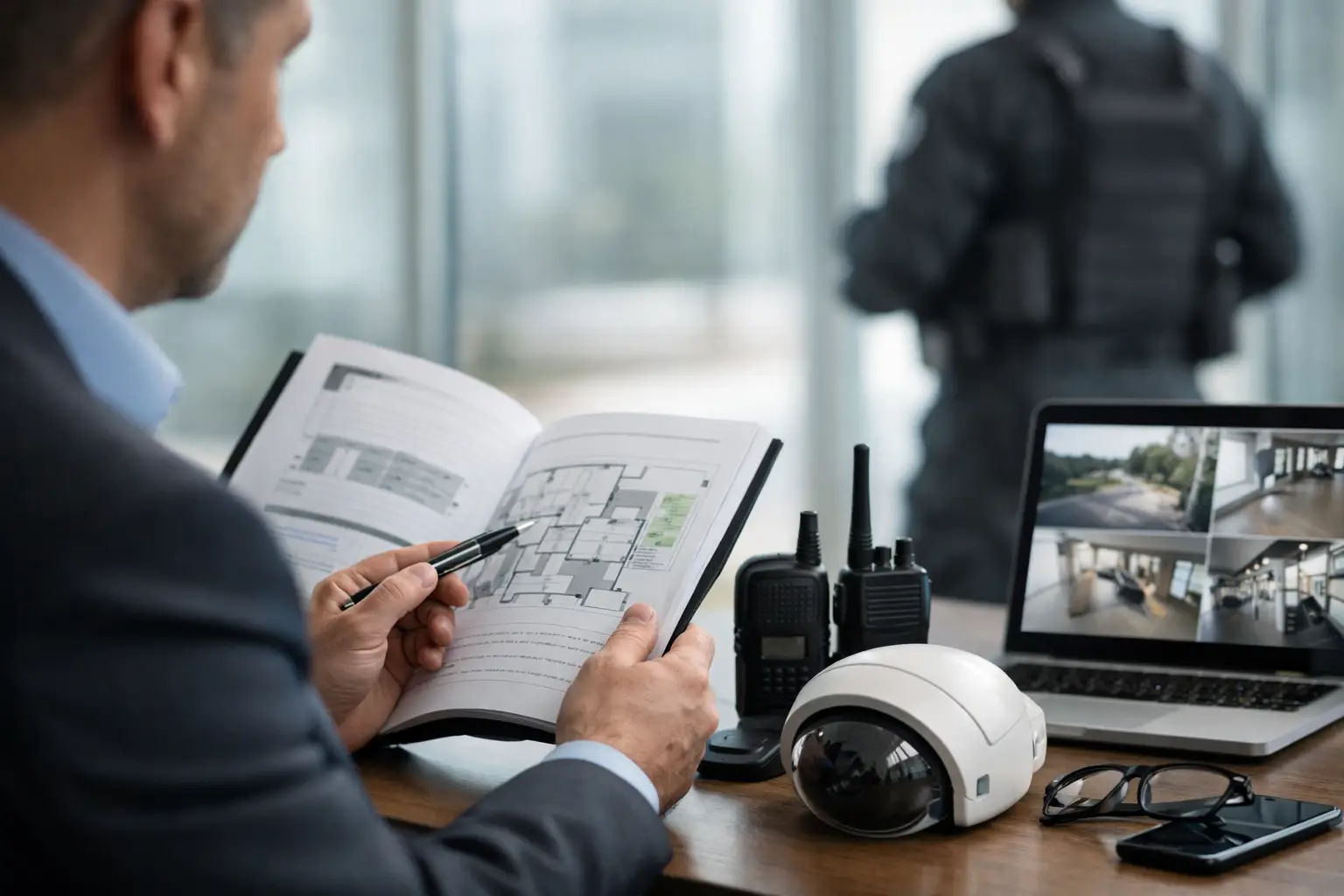
A venue can have enough officers on the ground and still be exposed. The usual failure point is not headcount. It is planning, briefing and control. That is where security consultancy Reading becomes commercially useful. For businesses, event operators and venue managers, good consultancy turns a security presence into a managed operation with clear objectives, defined escalation routes and fewer avoidable incidents.
Buying security advice should not feel vague. Commercial clients need practical answers. Where are the real risks? What level of staffing is proportionate? Who holds authority on site? What happens if a queue surges, a contractor breaches access rules, a guest becomes aggressive, or an incident attracts police attention? Consultancy should deal with those questions before the day starts, not once the pressure is already building.
What security consultancy in Reading should actually cover
Effective consultancy begins with context. A retail site, a school, a healthcare setting, a construction project and a live event all carry different threats, different legal duties and different operating pressures. A generic template will not do much for any of them.
For most commercial clients, consultancy should examine the site layout, public access points, staff routines, vulnerable areas, incident history and expected footfall. It should also account for the way the operation really runs, not the way it appears on paper. A loading bay used as an informal staff entrance, a side gate left open for convenience, or a handover process that depends on verbal memory rather than written instruction can all become weak points.
At venue and event level, the focus usually extends to ingress and egress, queue management, stewarding responsibilities, door supervision thresholds, search policy, response plans, welfare considerations and communication structures. The point is not to make an operation feel heavy-handed. The point is to keep it controlled, proportionate and capable of responding when conditions change.
Why businesses seek security consultancy Reading services
Some clients bring in consultancy after a problem. Repeated theft, disorder, trespass, poor contractor control or inconsistent incident handling tends to expose gaps quickly. Others seek advice earlier because they are opening a site, changing use of a venue, launching an event series or reviewing supplier performance. The second approach is usually cheaper.
A strong consultancy process helps decision-makers avoid two expensive mistakes. The first is under-provision, where visible cover looks adequate until a real incident tests it. The second is over-provision, where the client pays for manpower that does not match the risk profile. Both happen when planning is weak or copied from another site with different demands.
This is especially relevant in Reading and the wider Thames Valley, where many sites combine public access, contracted services, deliveries, peak-time congestion and multiple stakeholder groups. Office developments, mixed-use sites, hospitality venues and event spaces often need more than a static guarding brief. They need a joined-up operating plan.
The difference between staffing and consultancy
A buyer under time pressure may be tempted to start with numbers. How many guards? How many stewards? What hourly rate? Those questions matter, but they come after the operating model is understood.
Consultancy looks at command structure before deployment. It defines responsibilities between client teams, duty managers, security supervisors and frontline personnel. It sets briefing standards. It clarifies reporting lines. It identifies what must be escalated immediately, what can be managed locally and what evidence needs to be recorded.
Without that work, even experienced officers can be left making inconsistent decisions. One supervisor may challenge a breach firmly, another may tolerate it, and a third may not know whether the client expects intervention at all. That inconsistency creates risk for staff, customers and the client organisation.
Where consultancy is done properly, staffing becomes more effective. Officers arrive with a better brief, managers understand the priorities, and the client has a clearer view of what good performance looks like.
Planning matters most when the environment is live
The value of consultancy becomes obvious in high-pressure settings. A nightclub dealing with late-night intoxication, a stadium managing turnstile pressure, a festival balancing public flow with welfare, or a construction site handling multiple subcontractors all operate in conditions where hesitation causes problems.
In those environments, a written plan is only part of the answer. The plan must translate into practical briefing points, workable deployment positions and a chain of command that stands up under pressure. If it does not, the document may satisfy an internal file requirement but it will not improve security delivery.
What a good consultancy process looks like
The strongest consultancy work is disciplined and site-specific. It typically starts with a fact-finding stage. That may involve a site visit, a review of current procedures, discussion with leadership and operations teams, and analysis of previous incidents or known vulnerabilities.
From there, the work should move into recommendations that are clear enough to action. That may include changes to access control, revisions to staffing profiles, improved search procedures, revised patrol patterns, stronger handover routines or better incident communication. In some cases, the right recommendation is not more security personnel. It may be better lighting, clearer barriers, improved radio discipline or more defined authority for on-site managers.
This is where some buyers benefit from working with a provider that understands both consultancy and frontline deployment. Advice becomes more practical when it is shaped by operational reality. A recommendation needs to be capable of implementation by officers, stewards, supervisors and client staff on a live site.
Leadership briefings are often the missing piece
Many incidents are made worse by uncertainty at management level. Frontline teams can only do so much if senior decision-makers have not agreed priorities, authority levels or communications protocol.
Leadership briefings help align those points before deployment starts. They set expectations around risk appetite, incident thresholds, media sensitivity, welfare duties and external agency engagement. For commercial and event clients, that alignment reduces delay and improves accountability when something goes wrong.
Trade-offs that matter when choosing a consultancy partner
Not every client needs the same depth of support. A small private event with controlled access may need a lighter planning exercise than a public festival or a busy late-night venue. A distribution site with stable routines will have different consultancy needs from a mixed-use property with transient visitors and contractors.
That is why the best answer is often, it depends. More planning is not always better if it adds paperwork without improving control. Equally, a minimal review can be false economy if the site has obvious vulnerabilities, frequent public interaction or a poor incident record.
Buyers should also think carefully about whether they need standalone advice, support tied to a future deployment, or a broader review of policies and on-site practice. The right scope depends on the risk profile, internal management capability and how much change the client is prepared to implement.
Questions worth asking before appointing a consultant
A credible provider should be able to explain how they assess risk in practical terms, how they structure site briefings, how they define escalation routes and how their recommendations translate into daily operations. If the answer stays at the level of generic reassurance, push further.
Ask how they deal with live environments where public behaviour is unpredictable. Ask how they distinguish between stewarding, guarding and licensed intervention roles. Ask what information they need from your management team in order to produce useful recommendations. Ask how they support consistency across supervisors and shifts.
It is also worth asking how success will be measured. Reduced incident frequency is one marker, but it is not the only one. Better reporting, stronger access discipline, improved queue control, faster escalation and fewer avoidable disputes can all show that the operation is under better control.
Security consultancy Reading as a practical business decision
Good consultancy is not a paper exercise for compliance files. It is a way to reduce uncertainty before it becomes cost, disruption or reputational damage. For venues, businesses and event operators, the commercial value sits in better control of people, premises and incidents.
That is why experienced buyers tend to look beyond simple coverage rates. They want a provider that can assess risk properly, brief teams clearly and support an operation from planning through to live delivery. In a market where many services look similar at first glance, that operational discipline is often the difference between visible security and effective security.
Definitive Security Services takes that view seriously. The practical aim is straightforward: put the right plan in place, brief it properly, and make sure the site team knows exactly what good delivery looks like.
If you are reviewing your current arrangements, the useful question is not whether you already have security on site. It is whether the operation is set up to perform when the pressure comes on.
Leave a Reply