
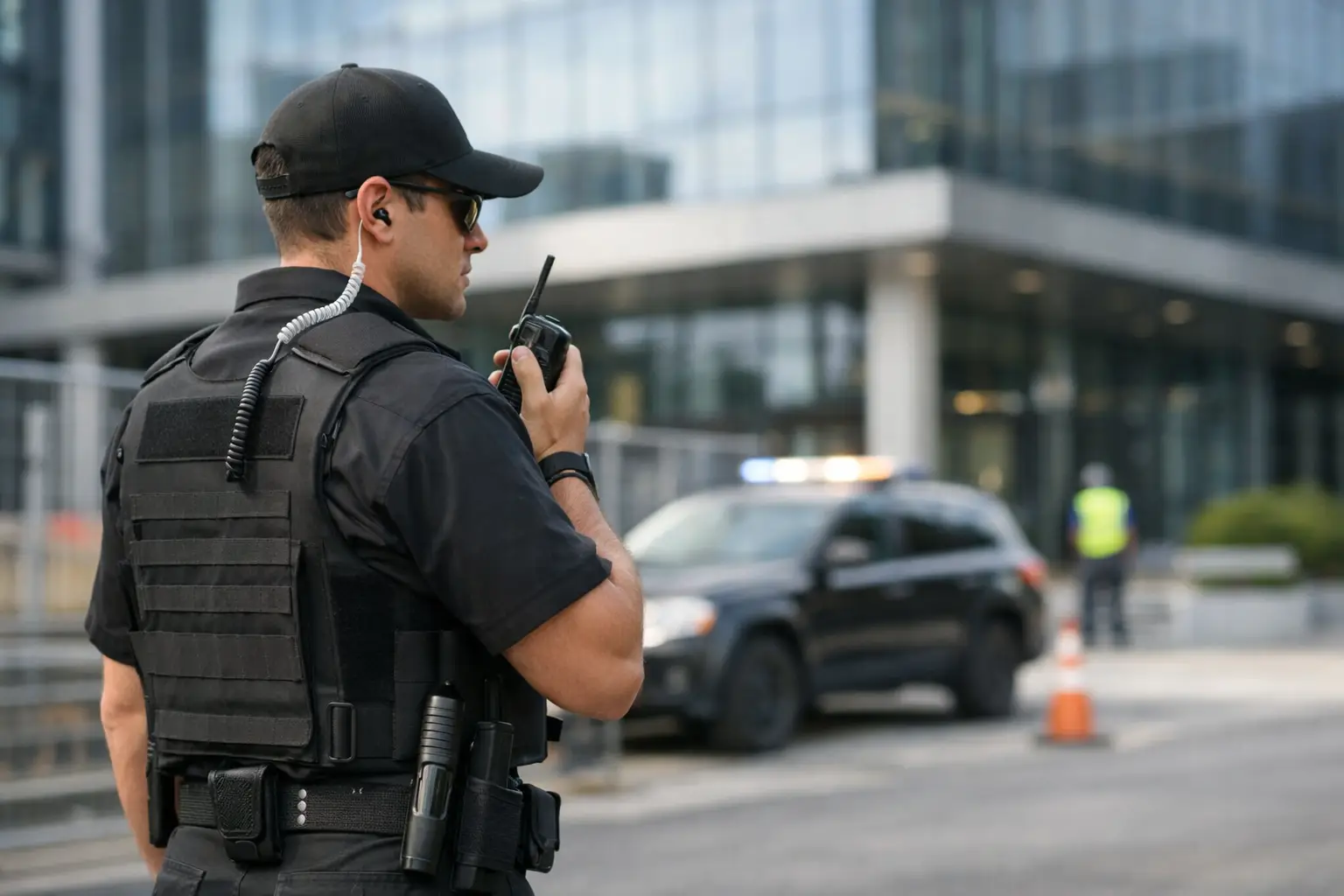
A gate left unsecured at 18:10, a contractor on site without clear sign-in records, an alarm activation with no verified response plan – this is where commercial site guarding stops being a line item and becomes an operational control.
This guide to commercial site guarding is written for businesses that need more than a visible presence. If you are responsible for a construction project, industrial unit, office estate, healthcare facility, retail premises or mixed-use site, the question is not simply whether you need guards. It is what standard of guarding will actually reduce risk, support operations and stand up when something goes wrong.
What commercial site guarding is meant to achieve
Commercial site guarding is often treated too narrowly. Buyers sometimes focus on deterring trespass, theft or anti-social behaviour, which are valid concerns, but those are only part of the picture. A properly managed guarding deployment should also improve site control, support health and safety procedures, maintain access discipline, record relevant activity and provide a clear escalation route when incidents occur.
That matters because many incidents do not begin as obvious security threats. They begin as small control failures – keys not accounted for, perimeter breaches not reported promptly, delivery vehicles arriving outside agreed hours, or staff and contractors moving through areas without challenge. Guarding is most effective when it sits inside a wider operational framework rather than acting as a reactive add-on.
A guide to commercial site guarding starts with risk, not headcount
One of the most common mistakes in procurement is asking for a number of guards before defining the site risk. Headcount should come after the assessment, not before it. A single well-briefed officer with clear authority, good supervision and a properly designed assignment can outperform a larger team working to a vague brief.
The starting point is the nature of the site. A vacant commercial property presents a different threat profile from a live logistics yard. A construction environment has issues around plant, fuel, tools, temporary access points and out-of-hours intrusion. A healthcare or education setting may require a stronger emphasis on safeguarding, access control and incident sensitivity. Retail and hospitality environments bring public interaction, conflict management and reputation risk into the equation.
Operating hours matter as well. Some sites need full-time guarding because activity and risk are continuous. Others need targeted coverage during handover periods, vulnerable overnight windows, shutdowns, maintenance works or high-value deliveries. There is no universal model. It depends on what needs protecting, when the site is exposed and how quickly a minor issue can become a serious one.
The difference between presence and control
A guard on site does not automatically mean a site is controlled. Commercial buyers should look closely at whether the guarding model creates real oversight.
That means understanding what officers are expected to do during a shift. Are they just positioned at an entrance, or are they conducting patrols with specific checkpoints? Are they monitoring access records, checking credentials and challenging unusual activity? Are incidents recorded in a way that helps management review trends and make decisions? If the answer is unclear, the deployment may be visible but weak.
Control comes from structure. Officers need defined duties, site-specific instructions, communication protocols and a clear reporting line. They also need to know what sits outside their remit. That is especially important on sites with multiple contractors, facilities teams or visiting personnel, where confusion around authority can create avoidable risk.
What to look for in a guarding provider
If you are assessing providers, the quality of planning should carry as much weight as the availability of staff. The guard on the gate matters, but the operating model behind that officer matters just as much.
A dependable provider should be able to explain how the assignment will be built. That includes site briefing standards, escalation routes, supervision arrangements, incident reporting, shift handover processes and expectations around client communication. If a provider cannot describe those points clearly, there is a fair chance the deployment will rely too heavily on individual effort rather than managed performance.
You should also test how well they understand your environment. A provider used to public-facing venues may bring strong conflict management skills, but a construction or industrial setting may need tighter perimeter discipline and stronger contractor control. Equally, a provider strong on static guarding may need a more tailored approach if your site includes public access, changing event risk or high footfall periods. Experience is valuable, but only where it is relevant.
Site briefings are not paperwork for its own sake
A weak briefing creates weak guarding. That sounds obvious, but many guarding issues can be traced back to officers arriving on site with limited context, unclear priorities or no practical understanding of the client’s operational risks.
A proper site briefing should cover access points, key holders, restricted areas, opening and closing procedures, emergency actions, known vulnerabilities, expected traffic, contractor protocols, lone working concerns and reporting expectations. It should also define what constitutes an incident, who must be informed and how evidence should be preserved if required.
This is where disciplined providers separate themselves from basic labour supply. Security officers should not have to work out critical procedures by trial and error. The assignment needs to be set up so officers can make good decisions quickly and consistently.
Technology helps, but it does not replace guarding
There is often a temptation to frame guarding against CCTV, alarms or access control. In practice, effective site security usually depends on combining them.
Technology can extend visibility, improve records and provide early warning. CCTV can support remote review, alarms can flag unauthorised entry, and access systems can create better audit trails. But none of those tools can physically challenge an intruder, assess behaviour at close range, manage a confrontation, or respond to a developing situation with judgement.
The trade-off is cost and proportionality. Not every site needs a heavily staffed guarding operation, and not every site needs complex electronic systems. In some cases, a guard service supported by existing site infrastructure is enough. In others, particularly where asset values are high or the operating environment changes quickly, an integrated approach is the stronger option.
Common failures in commercial site guarding
Most guarding failures are predictable. They tend to come from poor assignment design, weak communication or lack of supervision rather than from one isolated mistake.
A frequent issue is mismatch between the brief and the real site conditions. Another is unclear escalation, where officers report issues but no one is certain who should act. There can also be overreliance on static positioning when the site would benefit more from active patrols and access checks. On larger premises, poor handover between shifts can create blind spots that repeat day after day.
Buyers should also be cautious of deployments that look efficient on paper but leave no resilience for absence, surge demand or incident response. Commercial sites rarely operate in a perfectly stable pattern. Deliveries run late, contractors overstay, public-facing tensions flare up, and temporary works create new vulnerabilities. A guarding model needs enough structure to absorb those changes.
How to judge whether your current guarding is working
The easiest test is not whether incidents have stopped entirely. Very few sites operate without any issues at all. The better test is whether your guarding team is identifying, recording and controlling risk in a way that management can trust.
Ask whether access is consistently managed, whether site rules are being enforced, whether reports are useful rather than generic, and whether supervisors or account leads are providing meaningful oversight. You should also consider whether the guarding presence supports your staff and contractors operationally, rather than just occupying a post.
On a well-run assignment, clients usually notice better order before they notice fewer incidents. Sign-in procedures become tighter. Boundaries are enforced more consistently. Minor breaches are challenged earlier. Communication improves. Those are strong indicators that the deployment is doing its job.
Why the best guarding contracts are built around clarity
Commercial site guarding works best when expectations are explicit from the outset. That means clear site instructions, defined hours, agreed reporting standards, realistic coverage levels and a shared understanding of what success looks like.
For buyers across sectors such as construction, facilities, retail, hospitality and managed property, the strongest results usually come from providers who treat guarding as an operational service, not just a staffing exercise. That approach creates accountability at every level – from briefing and deployment through to supervision and incident response.
Definitive Security Services works in that way because reliable guarding is rarely about simply placing a uniform on site. It is about planning properly, briefing thoroughly and maintaining control when conditions change.
If you are reviewing your current arrangements, the most useful next step is to ask a simple question: does your guarding presence merely exist on site, or does it actively strengthen the way your site is run?
Leave a Reply