
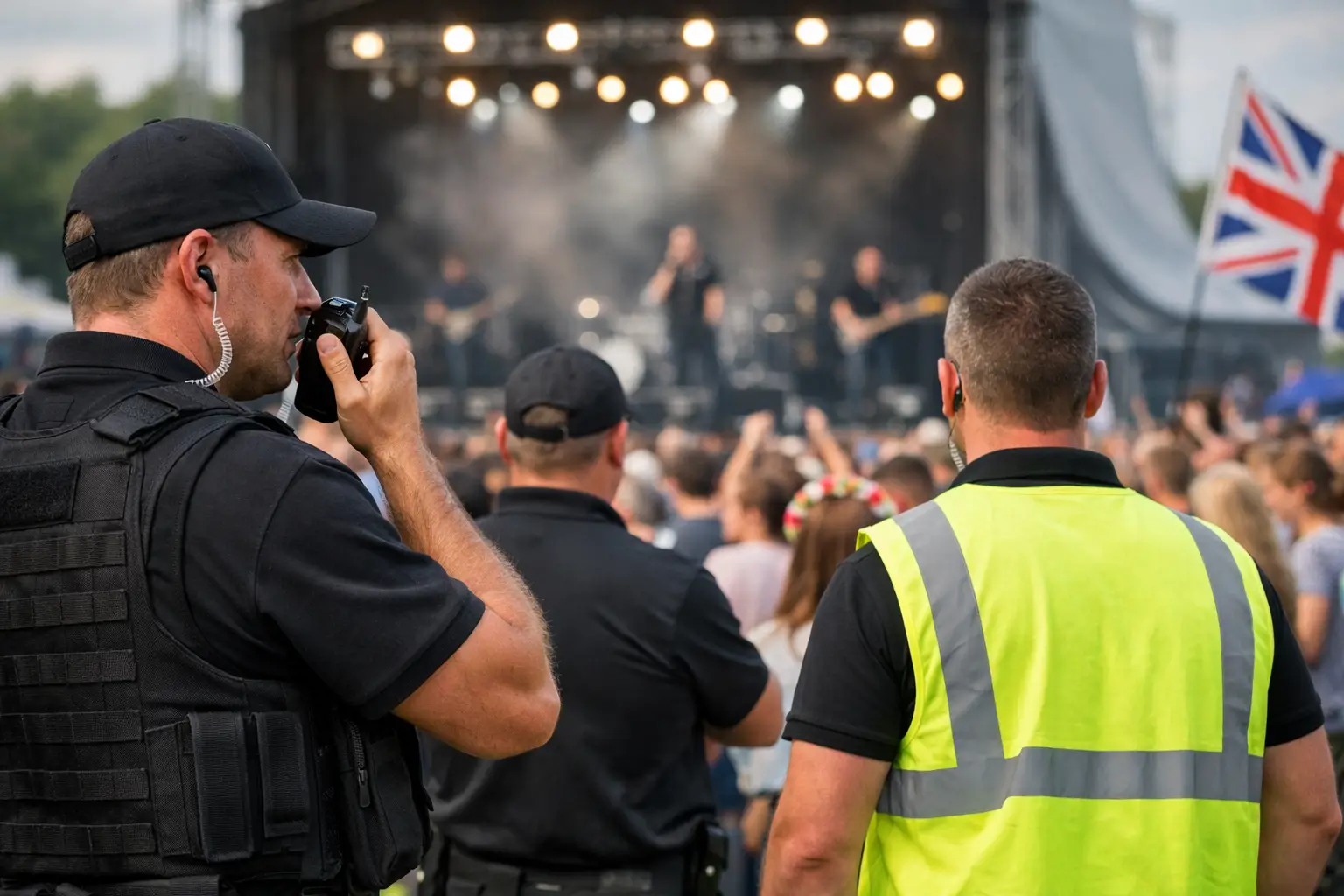
A festival can feel well managed right up until the gates open. That is the point where a security plan stops being a document and becomes a live operation. A strong festival security deployment example helps organisers test whether their staffing numbers, zone structure, command lines and incident procedures will hold up under real crowd pressure.
For commercial event organisers, venues and local authority partners, the issue is rarely whether security is needed. The issue is whether the deployment is proportionate, properly briefed and aligned to the way the event will actually run. A small music festival with licensed bars, vehicle movements and overnight camping requires a very different posture from a daytime community event on an open park. The detail matters.
A practical festival security deployment example
Consider a two-day outdoor music festival with a daily attendance of 8,000, a licensed perimeter, two public entrances, one staff and contractor gate, a backstage compound, a funfair area, a camping field and a taxi pick-up point. Trading runs from late morning to 2300, with egress continuing beyond that. Alcohol is on sale across multiple bars, and artists, contractors and catering teams require controlled access behind the public footprint.
In this example, security is not treated as a single block of labour. It is divided into functional zones with clear supervision. That distinction is what separates a planned deployment from a simple headcount exercise.
The outer layer covers perimeter integrity, vehicle gate control and early queue observation. This is where unauthorised access, ticket fraud, perimeter breaches and unsafe build-up around gates tend to surface first. The inner layer covers searching, public entry, pit and stage response, roaming patrols, bar support, welfare referrals and incident escalation. A third layer protects restricted areas such as production, artist access, cash handling routes and plant zones.
A typical deployment for this event might include an event security manager, zone supervisors, licensed door supervisors at public search lanes and bars, event stewards for wayfinding and lower-risk positions, and a mobile response team tasked with fast-time intervention. Numbers would depend on site design, licensing conditions, crowd profile and whether camping remains live overnight. The point is not the exact figure. The point is that every role has a defined purpose, reporting line and escalation threshold.
Building the deployment around the site, not the budget
One of the most common planning errors is starting with a target spend and then forcing the site into it. A better approach is to map the operational requirement first, then assess how to deliver it efficiently. Budget matters, but under-resourcing entrances or response capability often creates higher costs later through delays, disorder, refusals or medical pressure.
For the festival above, entry operations would usually be the first staffing priority. If the public arrival curve is compressed into a 90-minute period, search lanes and ticket resolution need enough personnel to keep queues moving without weakening screening standards. Slow entry is not only a customer service issue. It creates crowd density outside the gate, increases agitation and puts more pressure on frontline staff to process people too quickly.
The stage front is another area where generic ratios can be misleading. Crowd mood, artist profile, audience age range, weather and alcohol consumption all affect the pressure on barrier teams and pit extraction capability. A main stage with a high-energy evening programme may justify a stronger deployment than a second stage with similar headline attendance but lower crowd surge risk.
Camping changes the security profile again. Overnight presence is not simply about deterring trespass. It is also about fire watch, noise management, safeguarding concerns, missing person response and dealing with low-level disorder before it becomes a wider issue. That requires a different pace of supervision and a different briefing standard from daytime gate work.
Command structure in a festival security deployment example
A deployment only works if authority is clear. On a live festival site, confusion usually appears in the gap between observation and decision-making. Staff may spot an issue quickly, but if they do not know who owns the response, momentum is lost.
In this festival security deployment example, the event security manager sits within the wider event control framework and maintains direct contact with the organiser, safety lead and key operational partners. Below that, each zone supervisor controls a defined area such as entrance operations, arena patrols, backstage, camping or egress. Frontline officers report into those supervisors rather than working off informal instructions from multiple stakeholders.
This matters for accountability as much as for speed. If an incident occurs at a bar queue, the supervisor for that sector should know who is deployed nearby, what radio channel is in use, whether medical support is needed and when the issue needs to be escalated to event control. Without that structure, several people may react, but no one truly commands.
Briefings are equally important. A proper pre-opening briefing should cover site-specific risks, searching standards, challenge procedures, vulnerable person protocols, radio use, prohibited items, emergency rendezvous points and exact escalation routes. Staff should leave that briefing knowing not only where they stand, but what standard they are expected to hold.
Zone design and staffing logic
For an event of this size, zoning usually follows both geography and risk. Public entrances need dedicated teams because they deal with high throughput and frequent conflict points. The arena requires visible patrols, pit support and roaming response. Bars often need nearby licensed personnel because refusals, intoxication and queue frustration can combine quickly. Backstage and production areas need tighter access control and a lower tolerance for tailgating or pass misuse.
There is also a practical decision to make between fixed posts and mobile coverage. Fixed posts are useful where control points must never be left unattended, such as vehicle gates, search lanes and artist access. Mobile teams bring flexibility, especially when incidents cluster unexpectedly. Too many static posts can leave the operation slow to react. Too much reliance on roaming teams can weaken consistency at critical points. The right balance depends on the site plan and event behaviour.
Egress deserves separate planning. Many organisers focus heavily on ingress and stage-time operations, then assume the crowd will disperse naturally. In reality, egress often combines fatigue, intoxication, lost property issues, transport frustration and competing pedestrian flows. Security presence around exits, taxi zones and transport holding areas can reduce friction significantly.
What this example shows about risk and compliance
A sound deployment is not only about visible presence. It is about evidencing reasonable control measures. Organisers need to show that staffing decisions were linked to risk assessment, licensing requirements and foreseeable operational pressure points.
That means documenting why certain zones were prioritised, how many supervisors were assigned, what the response model looks like and how information moves across the site. It also means recognising where security should not carry the full burden. Some issues are better controlled through site design, barrier layout, signage, queue management, stewarding, welfare provision and traffic planning.
This is where experienced planning makes a measurable difference. If security is brought in early, deployment can be shaped around the event layout before weak points are fixed into the design. If security is only sourced at the last minute, teams often inherit avoidable problems such as poor access routes, confused accreditation systems or unrealistic gate plans.
Common weaknesses in festival deployments
The most frequent weakness is treating all heads on site as interchangeable. Door supervisors, event stewards, supervisors and control-level personnel do not perform the same function. Using the wrong mix can leave gaps in authority or capability.
The second weakness is underestimating supervision. A large frontline team without enough competent supervisors will struggle to maintain consistency across searches, incident reporting and radio discipline. The third is poor integration with the organiser’s own leadership team. Security should not be operating in parallel with event management. It should be part of a single operational picture.
There is also a tendency to overfocus on visible crowd-facing positions while neglecting service roads, restricted compounds and back-of-house routes. Yet many serious breaches begin away from the main audience, especially during build, breakdown and shift changes.
From example to live deployment
No two festivals need the same security model. Audience profile, music genre, operating hours, alcohol policy, site geography, transport links and local conditions all shift the requirement. Still, a good example provides a working standard. It shows how to break the site into zones, align staffing to risk, define supervision and prepare for incidents without creating unnecessary friction for attendees.
For organisers, the practical question is simple. Can your security provider explain not just how many people will attend site, but how the operation will function hour by hour, zone by zone and incident by incident? If they can, you are looking at a managed deployment. If they cannot, you may only be buying numbers.
The strongest festival operations are rarely the loudest. They are the ones where planning, briefing and control are visible in the decisions made long before the first customer reaches the gate.
Leave a Reply